
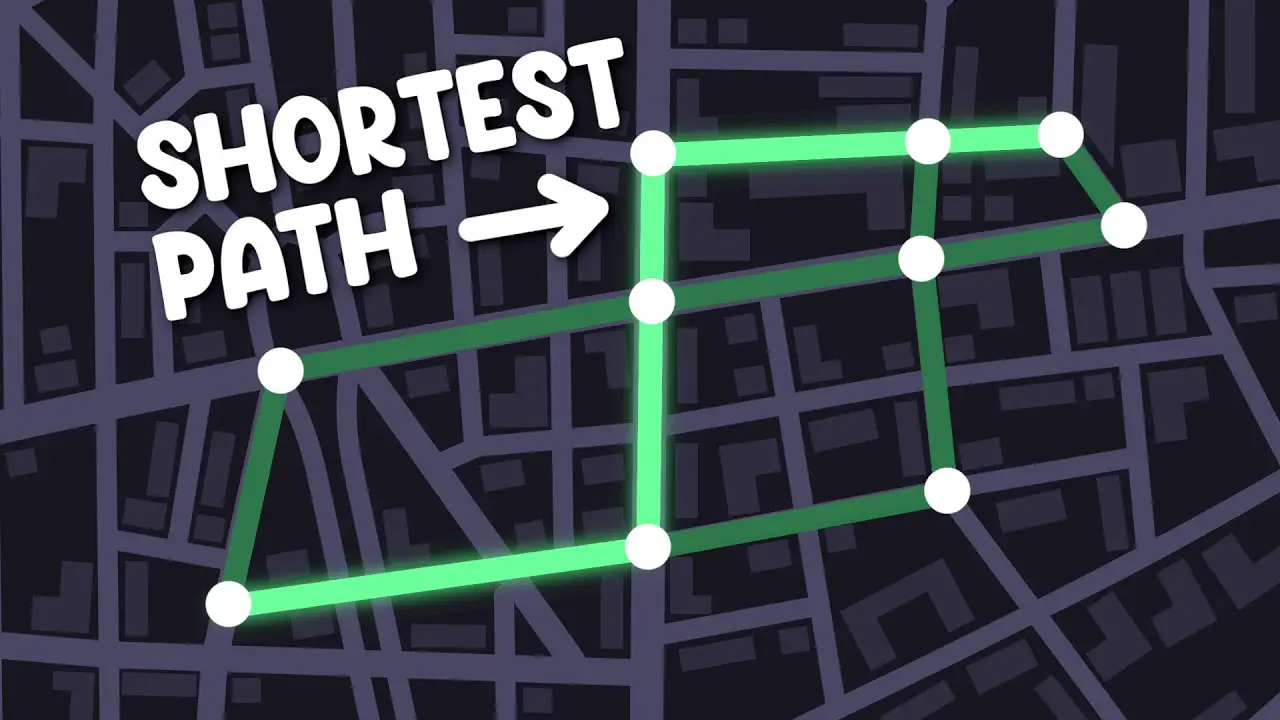
Shortest path algorithms are fundamental in computer science and have practical applications in many domains, such as navigation systems, network routing, and even game development. Two of the most commonly used algorithms for finding the shortest path in a graph are Dijkstra’s Algorithm and the Bellman-Ford Algorithm.
In this article, we will explore these two algorithms, understand how they work, and see how they can be implemented in Python. We’ll also discuss their strengths, limitations, and when to use each.
Understanding the Problem
Imagine you are driving an electric vehicle and want to find the route that consumes the least battery from your starting point (source) to your destination. The roads you can travel on are represented as edges in a graph, and the intersections or landmarks are represented as nodes. Each edge has a weight, representing the battery consumption needed to travel that route.
Our goal is to find the path that allows you to reach your destination with the most battery remaining.
Key Concepts
- Nodes (Vertices): The points in the graph, representing locations or intersections.
- Edges: The connections between nodes, representing the roads you can travel on.
- Weights: The cost or distance associated with an edge, in this case, the battery consumed while traveling.
Dijkstra’s Algorithm
Introduction
Dijkstra’s Algorithm was developed by Edsger Dijkstra in 1956. It is designed to find the shortest path between two nodes in a graph with non-negative edge weights. The algorithm works by visiting nodes in order of their distance from the source node, updating the shortest path to each neighbor, and marking nodes as “visited” once their shortest path is confirmed.
How It Works
- Initialization: Start by assigning an infinite distance to all nodes except the source node, which gets a distance of 0. Create a priority queue to keep track of the node with the smallest known distance.
- Relaxation: For the current node, update the distances to its neighbors if a shorter path is found.
- Selection: Remove the node from the queue, and repeat the process with the next closest node until all nodes have been visited.
Python Implementation
Let’s implement Dijkstra’s Algorithm in Python.
import heapq

def dijkstra(graph, start):
    # Initialize distances with infinity and set the start node distance to 0
    distances = {node: float('infinity') for node in graph}
    distances[start] = 0
    priority_queue = [(0, start)]

    while priority_queue:
        current_distance, current_node = heapq.heappop(priority_queue)

        # Skip if we found a better way
        if current_distance > distances[current_node]:
            continue

        for neighbor, weight in graph[current_node]:
            distance = current_distance + weight

            # Only consider this new path if it's better
            if distance < distances[neighbor]:
                distances[neighbor] = distance
                heapq.heappush(priority_queue, (distance, neighbor))

    return distances
Example
Let’s say we have the following graph:
A -> B (5), C (35)
B -> D (20), E (50)
C -> E (15)
D -> F (30)
E -> F (10)
We can represent this graph in Python as:
graph = {
    'A': [('B', 5), ('C', 35)],
    'B': [('D', 20), ('E', 50)],
    'C': [('E', 15)],
    'D': [('F', 30)],
    'E': [('F', 10)],
    'F': []
}
Let’s find the shortest path from node ‘A’:
distances = dijkstra(graph, 'A')
print(distances)
Output:
{'A': 0, 'B': 5, 'C': 35, 'D': 25, 'E': 50, 'F': 60}This output indicates the minimum battery consumption to reach each node starting from node ‘A’.
Limitations of Dijkstra’s Algorithm
Dijkstra’s Algorithm works well with graphs that have non-negative weights. However, the algorithm may not provide the correct solution if the graph contains edges with negative weights.
Bellman-Ford Algorithm
Introduction
The Bellman-Ford Algorithm was developed by Richard Bellman and Lester Ford in 1958. Unlike Dijkstra’s Algorithm, Bellman-Ford can handle graphs with negative weight edges. The algorithm is slower than Dijkstra’s but more versatile.
How It Works
- Initialization: Similar to Dijkstra’s, initialize all distances to infinity, with the source node set to 0.
- Relaxation: Perform relaxation over all edges for a number of times equal to the number of nodes minus one.
- Negative Cycle Detection: After the relaxation steps, if we can still relax any edge, it indicates a negative weight cycle.
Python Implementation
Let’s implement the Bellman-Ford Algorithm in Python.
def bellman_ford(graph, start):
    distances = {node: float('infinity') for node in graph}
    distances[start] = 0

    for _ in range(len(graph) - 1):
        for node in graph:
            for neighbor, weight in graph[node]:
                if distances[node] + weight < distances[neighbor]:
                    distances[neighbor] = distances[node] + weight

    # Check for negative weight cycles
    for node in graph:
        for neighbor, weight in graph[node]:
            if distances[node] + weight < distances[neighbor]:
                raise ValueError("Graph contains a negative weight cycle")

    return distances
Example
Let’s use the same graph but introduce a negative edge:
graph = {
    'A': [('B', 5), ('C', 35)],
    'B': [('D', 20), ('E', 50)],
    'C': [('E', -10)],  # Negative edge
    'D': [('F', 30)],
    'E': [('F', 10)],
    'F': []
}
Finding the shortest path from node ‘A’:
try:
    distances = bellman_ford(graph, 'A')
    print(distances)
except ValueError as e:
    print(e)
Output:
{'A': 0, 'B': 5, 'C': 35, 'D': 25, 'E': 25, 'F': 35}Negative Weight Cycles
Bellman-Ford can detect negative weight cycles. If such a cycle exists, the algorithm will indicate that the shortest path problem is unsolvable, as it would require traversing the negative cycle infinitely to decrease the path cost.
Performance Comparison
- Dijkstra’s Algorithm is faster with a time complexity of O(V + E log V) using a priority queue, where V is the number of vertices and E is the number of edges.
- Bellman-Ford Algorithm has a time complexity of O(V * E), making it slower but capable of handling negative weights.
Conclusion
Both Dijkstra’s and Bellman-Ford algorithms are essential tools for solving shortest path problems, each with its strengths and weaknesses. Use Dijkstra’s Algorithm for graphs with non-negative weights, and opt for Bellman-Ford when you need to handle negative weights or check for negative cycles.
Understanding these algorithms and their appropriate use cases is crucial for tackling real-world problems effectively.
